What an export invoice for services must show
Rule 46 of the CGST Rules lists what a GST tax invoice must contain: your name, address and GSTIN, an invoice number unique for the financial year (up to 16 characters), the date, a description, the SAC code for the service, the value, the tax rate and amount, and the place of supply. For an export, the rule adds the client's name, address and country, and one of two endorsements.
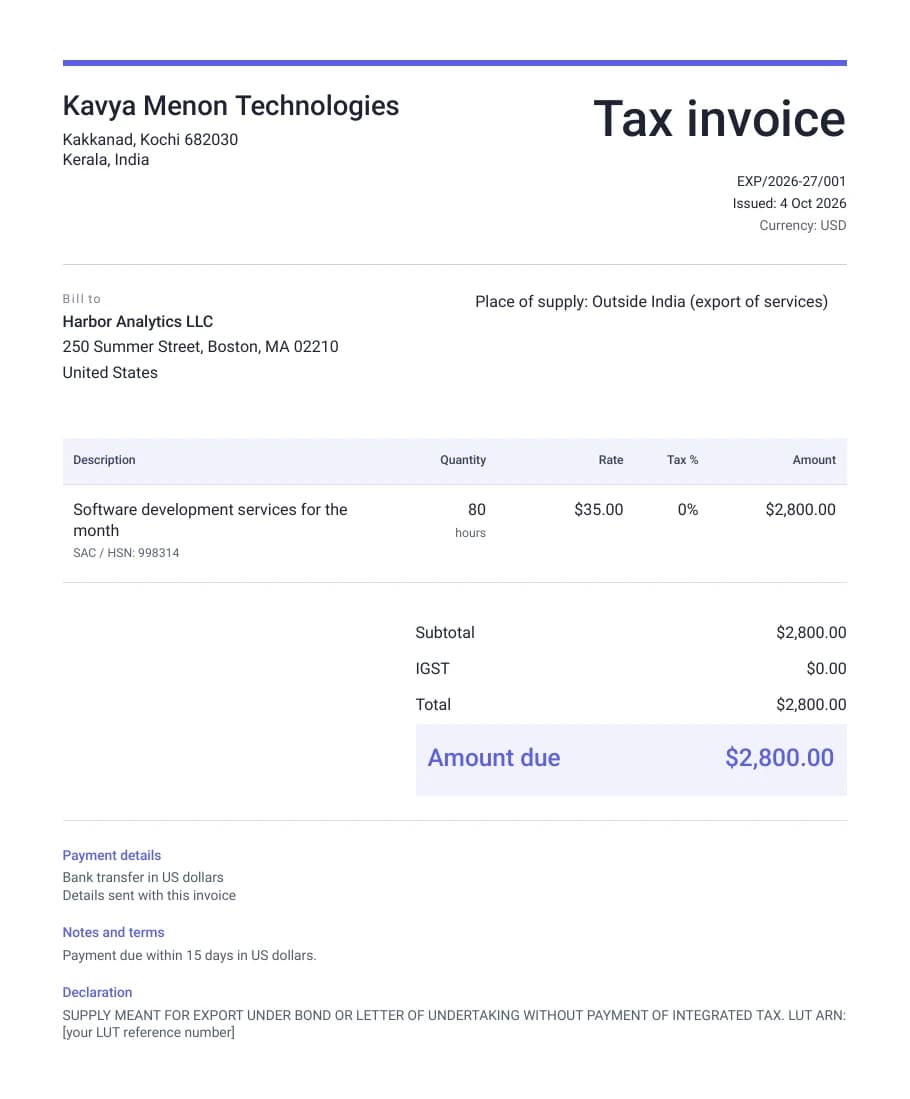
If you have filed a Letter of Undertaking for the year and do not pay tax on the export, the endorsement reads "Supply meant for export under bond or letter of undertaking without payment of integrated tax". The template puts it in the declaration and shows IGST at 0%. Many freelancers also print the LUT reference number (ARN) next to it, which is common practice rather than a rule.
The export invoice, field by field
Your details: name, address and GSTIN. Invoice number: unique for the financial year, up to 16 characters, such as EXP/2026-27/001. Date of issue. Client: name, address and country of destination. Place of supply: outside India. Description of the service with its SAC code. Value in the currency the client pays. Tax: IGST shown as 0% when you export under an LUT. The export endorsement. Your signature, which is not needed on an electronic invoice.
The template puts each of these in its place. Fill in your own GSTIN, LUT reference and SAC code before you download it.
Dollars, rupees and the payment record
Invoice in the currency the client pays, usually US dollars. For your GST return, the rupee value is worked out at the applicable exchange rate on the date of supply, which your CA or accounting tool can do. When the money arrives, your bank or payment provider gives you a record of the foreign payment; keep it with the invoice, because together they show that the service was exported.
If you are not registered for GST
Only a GST-registered business can file an LUT, so an unregistered freelancer has no LUT line, no GSTIN and no IGST on the invoice. Leave those fields empty and switch the tax setting to "No tax shown". Registration, the LUT and when you need them are explained in the GST and income tax guide.
Questions people ask
- What is an LUT in an export invoice?
- An LUT, or Letter of Undertaking, lets a registered business export services without paying integrated GST. It is filed online for each financial year, and the invoice then carries the export endorsement instead of tax.
- Which SAC code should I use?
- It depends on the service. The template's example uses 998314, which covers IT design and development services. Check the code for your own work in the CBIC classification, or ask your CA.
- Should the export invoice be in dollars or rupees?
- Invoice in the currency the client pays, usually US dollars. The rupee value for your GST return is worked out at the applicable exchange rate; your CA or accounting tool can do this.
- Is this tax advice?
- No. This page shows what the published rules say, checked on 4 October 2026. Ask a CA to confirm what applies to your business.
Sources: CBIC, CGST Rules, Rule 46: tax invoice (export endorsement) (checked 4 Oct 2026); CBIC, IGST Act, section 13: place of supply for services (checked 4 Oct 2026).
Last checked on 4 October 2026.