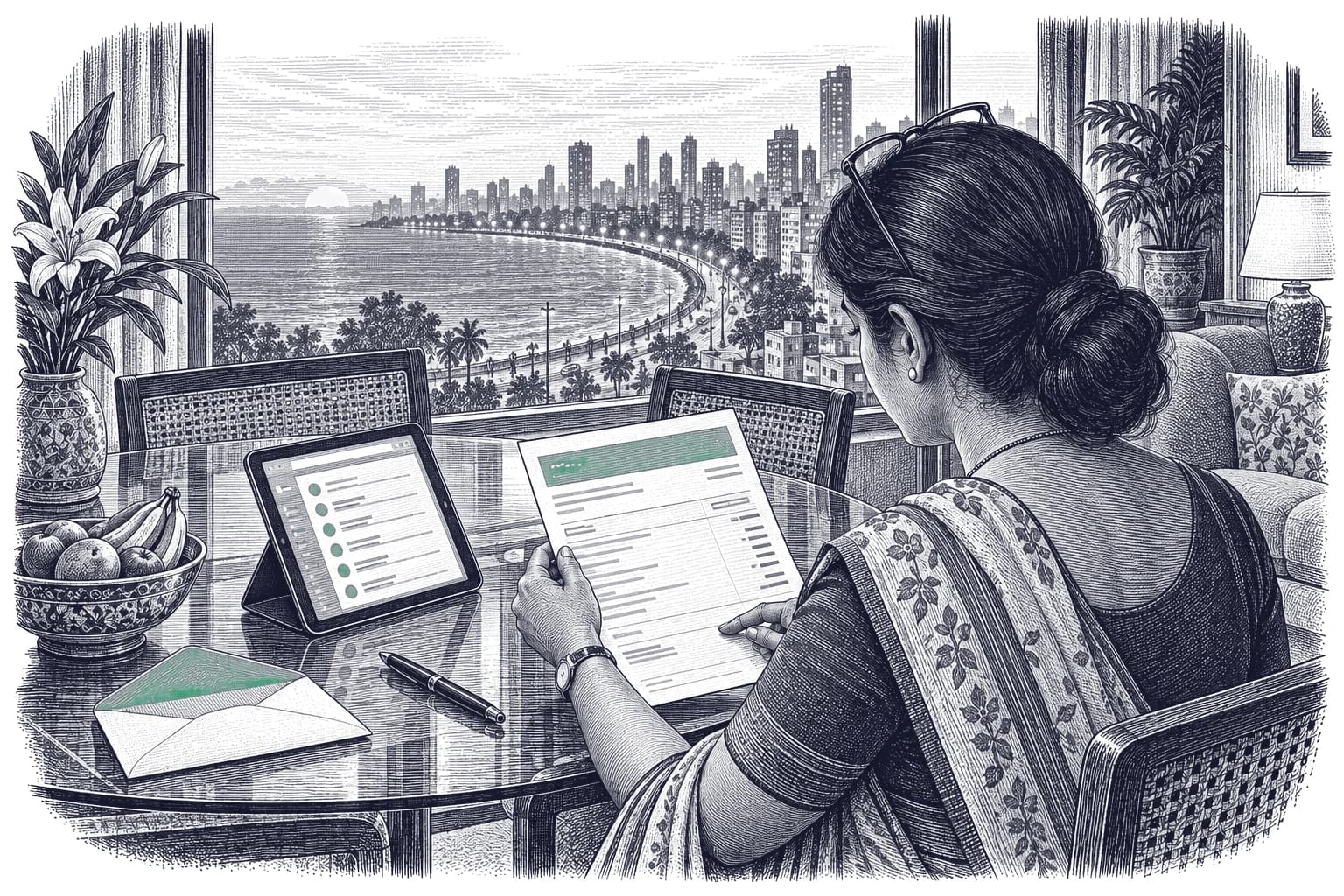
Are clients abroad slow to pay you, or are you worried they will be? Clients who came to me through references usually paid within two or three days of the invoice. What helped was agreeing the money before the work, sending a proper invoice that someone who has never met me can pay without asking a question, and, once I could estimate the work well, taking some or all of the money before I started.
Who actually pays your invoice
The person you work with is often not the person who pays you. In a small business, the founder may pay it themselves, between other things. In a slightly bigger company, you deal with one person, and a separate finance team pays the bills. The finance team has never spoken to you and did not agree the work, so everything it needs has to be on the invoice.
Whoever pays it needs to see, on one page, who you are, what the payment is for, how much it is, when it is due and exactly how to pay. If anything is missing, someone has to email to ask, and the payment waits for the answer.
Why payments get delayed: friction
Every extra step you put between a client and paying you is friction: a WhatsApp (opens in a new tab) message instead of an invoice, a payment method their bank does not use, a missing address, or an amount they were not expecting. None of these stops a payment on its own, but each one gives a busy person a reason to leave it for later.
Keep in mind the friction you create if you make it harder for them to pay.

One of my mentors told me the same thing early on, and How to get paid by international clients in India tells that story. Most of my clients came through personal references, and they usually paid within two or three days, sometimes a week. Only one client ever took a month or a month and a half. I talked about the money early in every relationship, so there were no surprises when the invoice arrived.
Step 1: agree the money before the work
The amount, how they will pay and when should all be agreed in a normal conversation before you start. The easiest moment is while agreeing the work: "Before I start, how does your team usually pay suppliers abroad? I can take PayPal (opens in a new tab), or a US bank transfer." The answer tells you which payment details to put on the invoice. The payments guide compares the routes and their fees, and the payout comparison shows how much each one leaves you with.
Step 2: make the invoice complete
Send the invoice as a PDF, and make it look like it came from a business.
Every invoice for a client abroad needs these:
| Field | Example |
|---|---|
| Your name, address and contact email | As on your bank account |
| The client's name, company and country | Acme Dental LLC, Ohio, United States |
| An invoice number that goes up each time | 014 |
| The date of the invoice and the due date | 3 October 2026, due 10 October 2026 |
| What the payment is for | Landing page, delivered 2 October |
| The amount and the currency | USD 250 |
| How to pay | Your PayPal link, or the account details from your payment provider |
| Who pays the transfer fees | "Fees on the sender's side are paid by the client" |
Once you are registered for GST, a few more details become compulsory. These include your GST number and one line of wording for exports under an LUT (a letter of undertaking, which lets you bill clients abroad without adding GST). GST and income tax for freelancers in India gives the exact wording.1 This is general information from my experience and the published rules, not tax advice, so check your own case with a chartered accountant.
Step 3: pick a tool
When I started, I made a PDF myself and later used an online tool called Invoicely. Now that I have an agency in the US, I raise invoices through Stripe, because a Stripe invoice is a format clients recognise and trust. Any of these works:
- The free invoice maker on this site, which makes a PDF invoice with your own logo in one of 12 designs, with no sign-up. There is a ready freelance invoice template and a consulting invoice template to start from.
- Invoicely (opens in a new tab), which offers free online invoicing for small businesses.2
- Stripe Invoicing (opens in a new tab), which charges a fee on each paid invoice, so check its pricing for your country first.3
Step 4: decide what to ask for upfront
Asking for money before you start protects you from a client who disappears after delivery, or who decides afterwards that the work was not enough. It is also harder to ask for when nobody knows you yet, so what you ask for changes as you gain experience.
For my first four or five years, I sent the invoice only after the work was done. Later, once I could estimate a job well, I started taking almost all of the money upfront. When I could not estimate it well, I took about 50 percent upfront and the rest on delivery.
| Where you are | What to ask for |
|---|---|
| Your early years, with clients who do not know you yet | Invoice after the work is done |
| You can estimate the work well | All or almost all of it upfront |
| The work is hard to estimate | About 50% upfront, the rest on delivery |
Once, I delivered a $600 list-building project, and the client said it was incomplete and asked for more work before paying. I decided to let it go and move on. With a 50% deposit, half of it would already have been paid before the question came up.
Whatever you agree, put it in writing before you begin, even if it is only an email: "50% before I begin, 50% when the page is live" is enough.
Step 5: when a payment is late
Late payments have been rare for me. When one happens, I send a friendly reminder on the due date and a few more at fixed points before I call. The messages I send, in order and with the wording, are in how to ask a client for payment politely.
A worked example
Say you design mobile app screens, and a small US startup has asked you for the screens of its sign-up flow.
- Before the work. On the first call you agree USD 800 for the flow, and ask how they usually pay suppliers abroad. They pay by bank transfer, so you note that for the invoice. The work is new to you and hard to estimate, so you ask for 50% before you start.
- The first invoice. You send invoice 001 for USD 400, "50% deposit, sign-up flow screens", due in seven days, with your account details and a line saying the client pays their own transfer fees. The founder forwards it to their bookkeeper, who pays it three days later without a single question.
- Delivery. You deliver the screens and send invoice 002 for the remaining USD 400 on the same day.
- A late payment. The due date passes. You send a friendly reminder, then another two days later, then a short email asking whether anything is holding it up. The bookkeeper replies to that email that it was missed while the founder travelled, and pays that afternoon.
Before your next invoice
- Make an invoice template with every field in the table above, using any of the tools listed.
- Ask your client how they prefer to pay during your next conversation about the work, before the invoice.
- Write down the payment terms you will offer at your current stage: after the work, 50% upfront, or all upfront.
- Start a payment log: the invoice number, the date you sent it and the date the money arrived.
Sources
- 1CBIC, CGST Rules 2017, rule 46 (tax invoice, export endorsement) (opens in a new tab)Checked 28 Sep 2026
- 2Invoicely, free online invoicing for small businesses (opens in a new tab)Checked 28 Sep 2026
- 3Stripe, Invoicing pricing (India) (opens in a new tab)Checked 28 Sep 2026