

Charging $10 or $15 an hour for work you have done for years? I was there for a long time. I started freelancing at $5 an hour in 2017 and 2018, which is about ₹470 an hour at today's rate.1 It took me five to six years to reach $18 an hour. Today I charge $150 an hour. No client held me back in those years. I held myself back, because I priced my skill the way I was paid in a job: by the hour.
The client who said yes to $35
In January 2025, I quoted $35 an hour to a new client in the US. The client agreed without a pause. He said, "Okay, let's try this for about a week," and we signed the contract the same day. I started the work the next day.
Slowly, I realised this client was better than all the clients I had before. He spoke to me with more respect. He asked for my advice instead of telling me what to do, and he gave me the freedom to try things. Most of my clients at $5, $10 and $15 an hour had micromanaged me. I am not against those clients, but that was the pattern I saw.
Why I priced myself like an employee
When I started, I worked out my rate from my salary. I divided my salary into an hourly price, and it came to $7 or $8 an hour.
I think many of us in India are wired to price by time. We are paid for our hours, so we count our hours. If my work brought a company $10,000, my mind went straight to how long it took me: two hours, five hours or ten. I think many businesses in the US and Europe look at it from the other end. They pay for the value you add. Say you work 10 hours on a project and it brings the client $5,000 of profit. Charging that client $1,000 is fair. This idea is called value-based pricing. I did not know about it when I started. Even if I had read about it then, I would not have understood it.
The day I changed my rate
At the end of 2024, I was charging about $18 an hour for my Clay (opens in a new tab) work on Upwork (opens in a new tab). Around then, I was a student in Bootprint, which was called Clay Bootcamp at the time. It is a community of serious go-to-market engineers, the people who build sales and marketing systems for companies. I saw people there charging about 10 times my rate for the same kind of work. That is when I realised that it was me who was holding myself back.
A mentor who knew the market heard my story. He said, "Bharat, you're charging very low. You should be charging $75 an hour." I was not ready for $75. In my head, I was not doing $75 worth of work.
I made one decision after that call. When an expert recommends something, I try it without running it through my logical brain first, unless it could seriously hurt me or my business. A higher rate could not hurt anything. So right after the call, in January 2025, I changed the hourly rate on my Upwork profile to $75, his number. Then I emailed him a screenshot of the change.
 (opens the full-size image)
The next day, a new client came, and I quoted $35.
On the call I just forced myself to say the price. Mentally I wasn't ready to say $35, because in the back of my mind I was undervaluing myself: "You're not worth $35." So I just said it.
Testing the ceiling
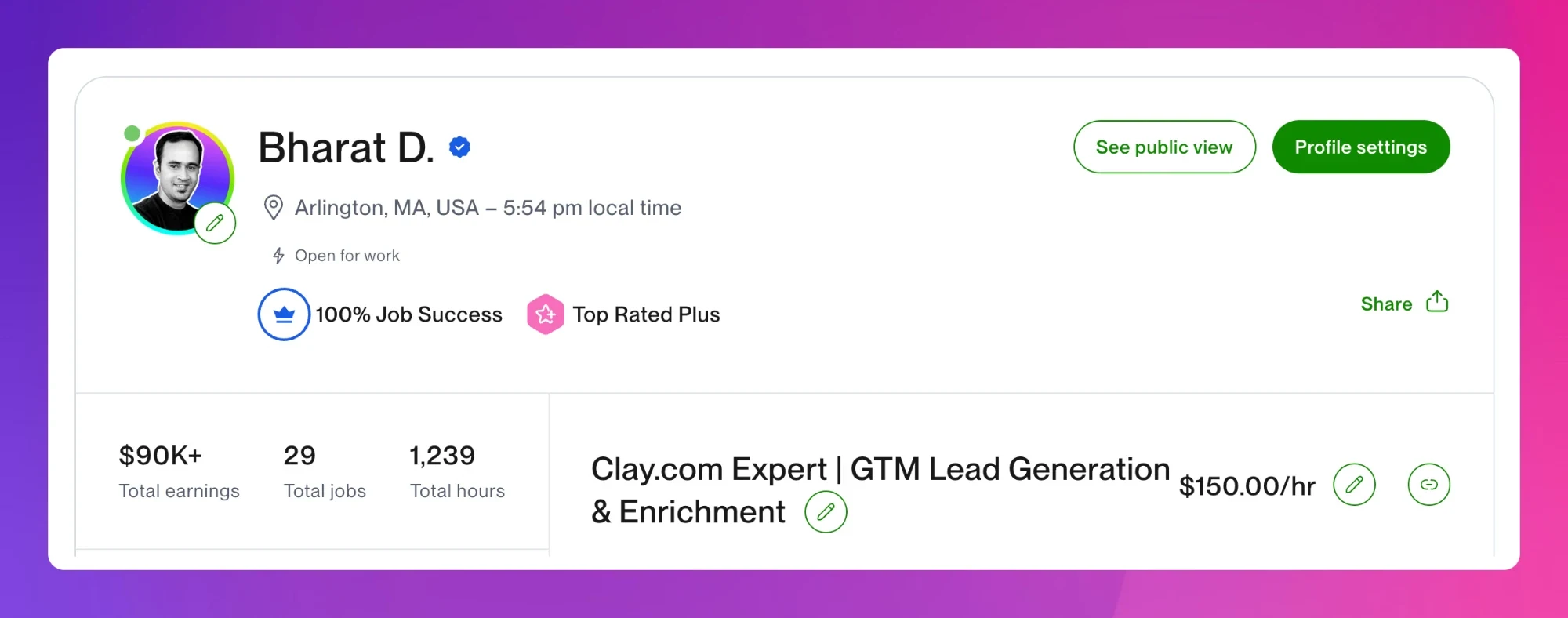
After that, I tested a higher rate with every new client: $35, then $45, $50, $75, $100 and $150 an hour. One or two people said no at $75 or $100. They said it politely and told me it was not their budget. I had expected people to laugh at me or ignore me, and nobody did. I also tried $200 and $250 an hour as an experiment. At those rates, many more people said no. A handful still said yes at $150, so $150 became my ceiling.
 (opens the full-size image)
Today, one go-to-market engineering project pays me $5,000 to $7,000 a month. That is what one project pays, not my total income. I talk to those clients once or twice a month. They trust me and ask for my advice, and they do not direct my work. These are my figures as of November 2026, a reference point and not a promise.
My friends in India are still surprised by my rate. They do work very similar to mine, and they ask how I can charge $100 or $150 an hour for it. I find it very hard to explain logically. They just need to try it and see.
What I would tell someone charging $15 an hour
Price the value, not the hours. Before you quote, think about what the work is worth to the client, not how long it takes you. How to charge international clients from India covers how to set your starting number.
Let one expert push you past your own judgement. Someone who knows your market may tell you that your rate is too low. Try their number, or a step towards it, with your next client.
Test a higher price with each new client. How to raise your rates as a freelancer explains how to raise your rate in steps and say the number plainly.
Note every polite no. When someone says no politely to a higher rate, write the rate down. A few of those show you where your ceiling is. Client asking for a discount? What to say covers how to answer.
If nobody says yes at the higher rate for two months, look hard at your skill. Ask whether the work really adds value to the company paying for it. Simple work such as data entry or form filling will not earn $50 or $100 an hour. In that case, improve your offer or learn a newer skill.
Next month
Say you charge $15 an hour, you really know your work, and you have worked with at least one or two clients. Then raise your price to $35 to $50 right away. Quote that price to every new client for the next one or two months, and note how each one responds. Most of the time, the answers will surprise you.