
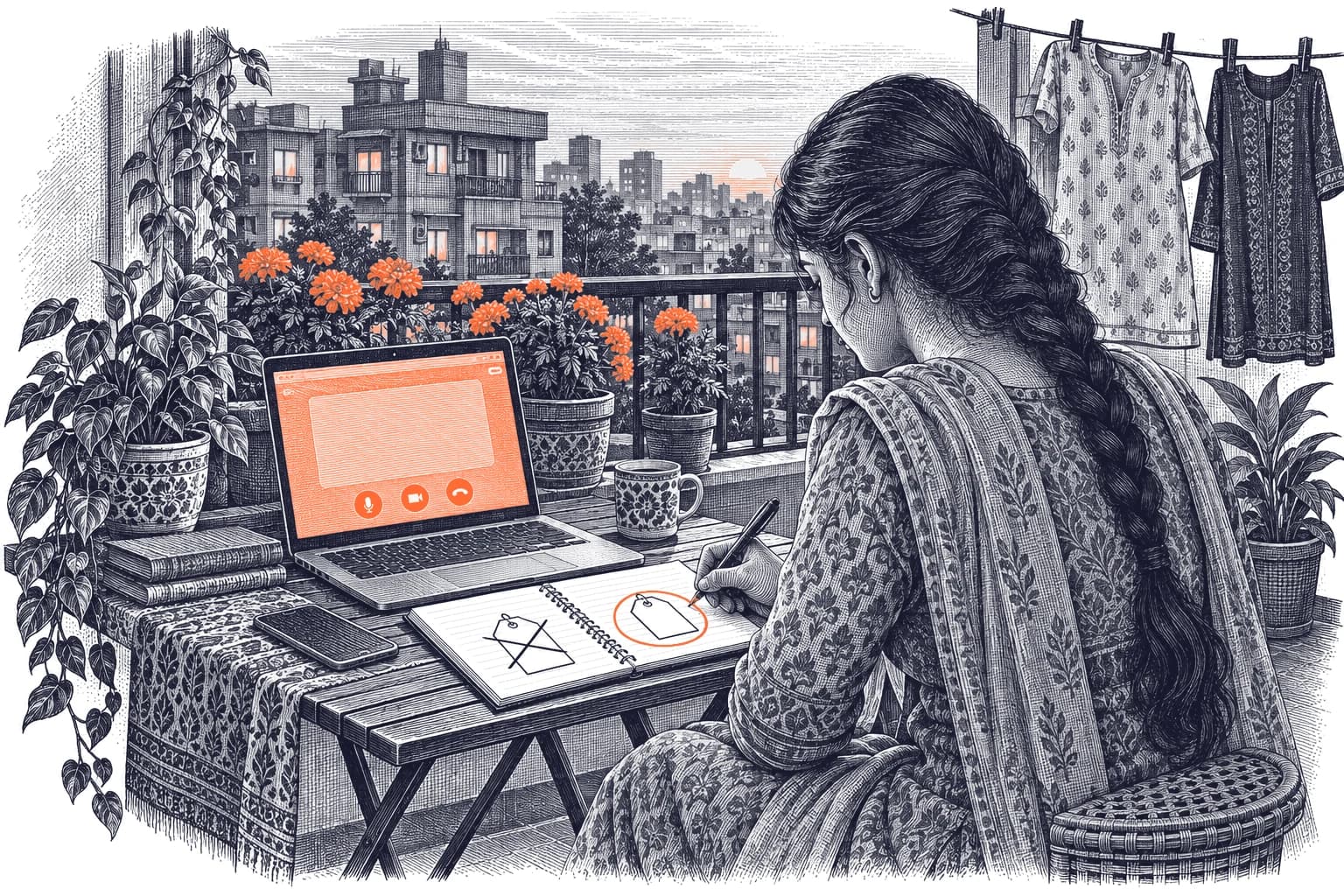
Has a client asked for a discount, and you are not sure whether to give in? You do not have to say yes, and you do not have to say no straight away either. Decide your real price before you quote, quote a little above it, and if the client asks, come down once to your real price and hold it there. If their budget is far below even that, say plainly that the budget does not work, or offer a smaller piece of work that is useful on its own.
Why the client is asking
From the client's side, a discount request is usually one of two things. Most of the time it is a request to negotiate. Sometimes it means your price is out of their range, and no small change will fix that. In my experience, discount requests of either kind are rare, far rarer than I expected when I started, and How to raise your rates as a freelancer tells how few of my clients pushed back at all.
The two need different answers: a negotiation needs a small, planned step down, and a budget far below your price needs a clear no or a smaller piece of work. Doing the whole project for their number would mean working at a price you had already decided was too low.
Some clients abroad also expect a lower price because you are in India. Why clients expect Indian freelancers to be cheap explains that, and why a low price is hard to raise later with the same client.
Leave room for one step down
Negotiating is a sales skill, and people build it slowly. You do not need the whole skill to handle a discount request, though, because one simple method covers most of them.
I usually have a number in mind, let's say $30. I would quote $35 or $40, and if they ask, I come down to $30 and hold it there. Mark it up a little, assuming they will ask for a discount. You might be surprised that sometimes people don't ask at all.
Work out your real price before the call, from your minimum rate and what the work is worth to this client, and write it down. The quote is that number plus a margin you are willing to give away, about a fifth to a third on top, whether you charge by the hour or by the project. These numbers are examples at ₹96 to the dollar, honest as of September 2026, and a reference point rather than a rule.
| Your real price | What you quote | If they ask for a discount |
|---|---|---|
| $30 an hour (about ₹2,9001) | $35 to $40 an hour | Come down to $30 and hold |
| $1,000 for the project (about ₹96,0001) | $1,200 to $1,350 | Come down to $1,000 and hold |
What to say
Come down once, then hold. Keep the reply short and friendly.
- Coming down once: "I can do $1,000 for the project. That is the lowest I can go and still give it the time it needs."
- Holding after that: "I understand if that is more than you planned for. $1,000 is my price for this work."
If they do not ask, say nothing. When a client accepts your first quote, do not offer a discount they did not ask for. A lot of salespeople say that if nobody pushes back on your price, you are not charging enough.
When the budget is far below your price, say so. One of the hardest no's I have said was on a project I quoted at $4,000 to $5,000. The client said their budget was $1,500 to $2,000, which was very low for that work. I told them directly that the budget did not work, because the project needed a lot of my time, and I declined politely. They did not reply after that. The other choice is to offer less work for less money. Sometimes I do offer a small first piece of work instead, if that piece is valuable on its own, and whether it is depends on the project.
- Saying the budget does not work: "Thank you for telling me your budget. This project needs a lot of my time, and $1,500 to $2,000 does not work for it."
- Offering less work for less money: "For $1,500, I can do the first part of this well, and it will be useful on its own. We can talk about the rest after that."
A discount can also arrive as extra work at the same price. My rule there is that a 10 or 15 minute extra I just do, and anything over half an hour gets a price before I start. How to say no to a client without losing them explains that rule and the other no's.
Before your next quote
- Write down your real price for the work, the lowest you will accept. That is your one step down, decided before the call.
- Add a margin on top, as in $30 quoted as $35 or $40, and quote that.
- Note after the call whether the client asked for a discount at all.
If clients keep accepting your first number without asking, raise your real price for the next one. For how to set that price in the first place, see How to charge international clients from India and the steps on the growing page.