
Worried about what your family will say if you leave a salaried job to freelance? In my experience, most relatives do not object to freelancing itself. What bothers them is that they cannot explain it to anyone else, and in an Indian family people ask your parents about your career too. So give your family one short sentence made of words they already use, keep your plans quiet while you are still testing, and let them see the proof as it comes. For me, the questions faded because of things my family could see for themselves.
How it looks from the family's side
At my cousin's wedding, an aunt asked me what I was doing these days, and I said freelancing. After a pause she said, kindly, "Oh. So you don't have a job." I told her I worked from home for small businesses in the US, and she asked the one question I had no answer for: "Which company?"
My aunt was going to repeat my answer somewhere later that week, in a sentence that began with my mother's name. She needed one line she could carry home, and I had given her nothing to carry. In India, a career is judged as the family's. When a relative asks what you are doing now, they are also asking how your parents did. Your job, your title and your city are the news that travels to the next function, and a company name travels easily.
I knew this pattern from much earlier. When I left school in the 8th standard, relatives went to my parents, not to me, and asked why they were not forcing me to study. My father pushed back without being harsh: "That's not your business. Let him decide what he wanna do." My mother took the questions as worry and told me that people were asking, but she never once told me to do what they wanted. My own worry as a boy was that my parents were getting the pressure, and they could not fully control it.
Proof before belief
My rule for this is proof before belief. Your relatives do not need to believe that freelancing is real work. You show them, over time, that it works for you, and you let them reach their own conclusion.
About ten years ago, I tried explaining. I said freelancing, and nobody knew the word. I tried gigs, and nobody knew that one either. So I described small jobs from the US and Europe that I did at home on a computer, and each explanation made the conversation longer. In the end I said "I am working from home" and stopped there.
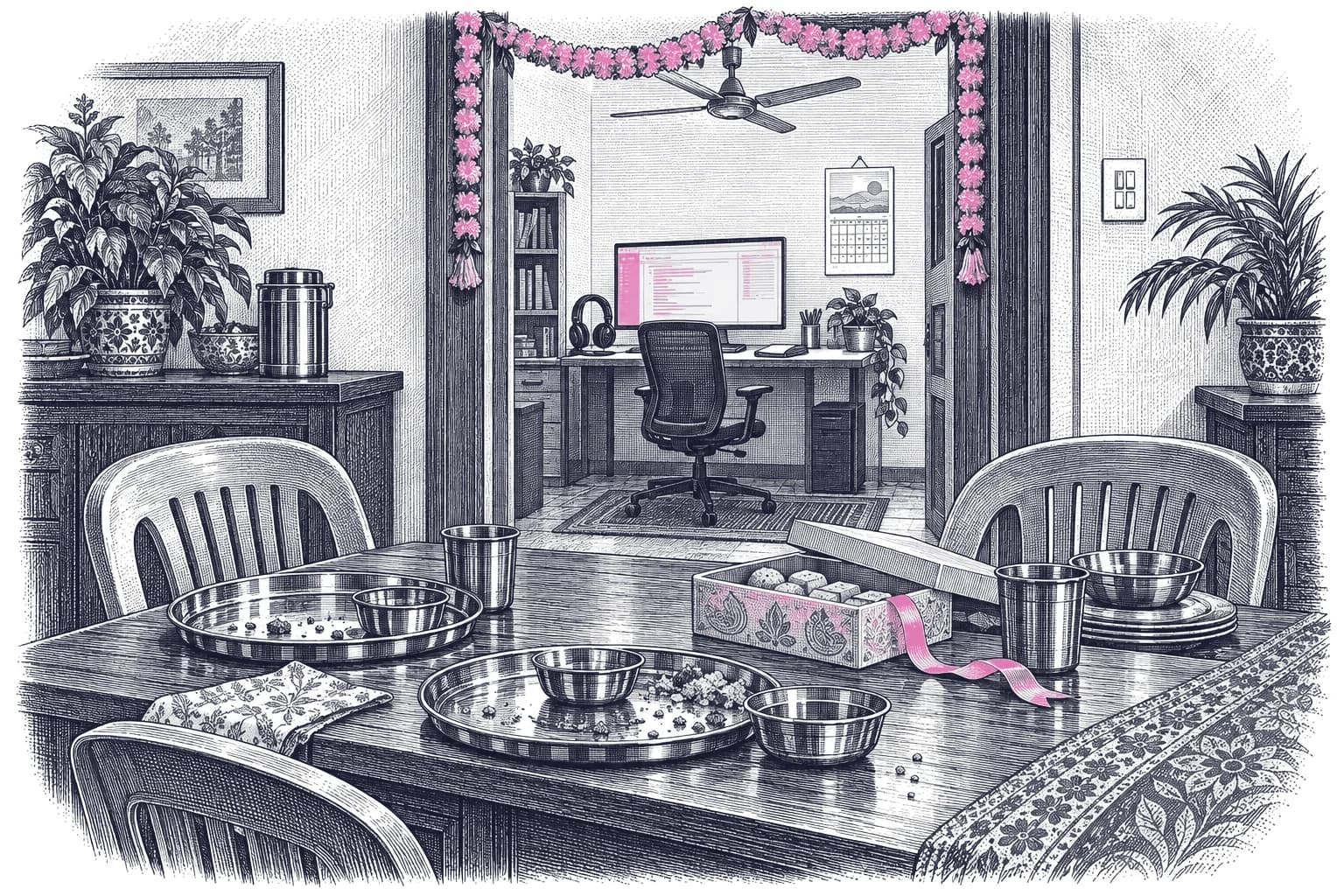
What changed my family's mind came in stages I never planned. I was living at home at the time. My parents never followed the work itself. Every day, though, they saw a big monitor on my desk and heard me on calls in English with people in other countries. Then a whole year passed with no job, and after the first few months nobody had to support me. By then my freelance income was comparable to a senior software engineer's salary. About two and a half years in, a US healthcare client needed far more help during COVID. I set up a small office and brought in four or five friends as temporary contractors. Every relative understood an office. Later my wife's company sent her to the US and I went with her, and relatives do not question a move to the US. Years later, the same uncles and aunts began asking me about their own children.
They ask, can you advise your cousin on what to do next? He or she is not able to do the job. Do you think they can also get into something like what you're doing, sitting at home and doing stuff? They completely don't understand it, but those conversations did happen.
What to do until the proof arrives
Give them one sentence in words they already know. Leave out the word freelancing. Name the kind of client, the country, what they pay you for, and that they pay in dollars. Say you keep the accounts for two small shops in America. "Two shops in America pay me in dollars to keep their accounts" uses only words your relatives know. My answer at the wedding named no client, no task and no money, so the aunt had to ask for a company name. This sentence names all three, which gives a relative something to repeat.
Give your parents the same sentence. They will be asked more often than you, and it is easier for them when every relative hears the same version.
Keep it quiet while you are still testing. For about a year, maybe a year and a half, I skipped most weddings and functions. I was confident about the work and had no idea yet whether it would last. My first three months brought in no money at all, and every announcement would have started questions I could not answer. I started going to weddings again once the income was steady, long before anyone stopped asking. This only holds for the testing months, while there is nothing to show yet.
Build one thing people can see without you explaining it. For my family it was the monitor and the calls. For you it might be a page showing your work (How to build a freelance portfolio without clients), a profile with real client reviews, or one client who will happily say your name. If the worry at home is really about job security, read Job security in India: is a salaried job really safe?.
Before the next family function
- Write your sentence with your kind of client, their country, what they pay you for, and the currency. If the word freelancing is still in it, write it again.
- Read it out to your parents, so they have the same line when someone asks them.
- Decide what stays private. Your rates, your clients' names and how you find work do not need explaining at a wedding.
- Put the date of the next function in your calendar, and next to it write the one thing people should be able to see by then: a page of your work, a first review, or a client's name.